Active recall: why retaking practice tests beats rereading
Rereading gives you a comfortable sense of mastery, but the experiments show it is an illusion: students who test themselves remember far more days later. I walk through the research behind the testing effect — and how I apply retrieval practice in SimulAI without memorizing answer keys.
Of all the features I built into SimulAI Academy, the practice test generator exists for the simplest reason: rereading does not work, and almost everyone studies by rereading. Myself included, for years. I spent much of college highlighting handouts and running my eyes over the same pages, convinced I was learning — until I ran into the research on retrieval practice and understood why that feeling of mastery kept evaporating at exam time. In this article I want to lay out what the research actually says about testing yourself versus rereading, including the specific experiments that changed how I study and how I built the platform — and also where active recall fails, because no method is immune to misuse.
Almost everyone studies the least efficient way
This is not just my impression. Karpicke, Butler and Roediger (2009) asked college students which strategies they used to study. Rereading notes and textbooks dominated the answers as the number-one strategy, while only a small fraction reported testing themselves — and even among those, most used testing merely to check whether they already knew something, not as a learning tool in its own right. In other words: the most popular strategy is one of the least effective, and the most effective one is used by few people, for the wrong reason. When I read that survey, I recognized my own student habits exactly.
The illusion of knowing has an explanation
Why is rereading so deceptive? Because it produces fluency. With each pass, the text flows with less friction: your eyes glide, nothing surprises you, everything seems obvious. The brain reads that ease of processing as mastery — “I recognize this, so I know it.” But recognizing information while it sits in front of you is a completely different skill from retrieving it on your own, with no cues, when a question demands it. The exam tests the second skill; rereading trains (and measures) only the first. That gap is the illusion of knowing, and it explains the student who “knew everything” at home and froze in the exam room.
The home test is simple: close the material right now and explain out loud what you just read. If the words do not come, you recognized the text — you did not master it. Finding that out is uncomfortable, but far better at home than in the exam.
The experiment that changed how I think about review
The study that struck me hardest in this literature was published in Science by Karpicke and Roediger (2008). Students learned foreign-language vocabulary, and once each word had been recalled correctly for the first time, the researchers varied what happened next: keep studying the item, keep being tested on it, or drop it entirely. A week later the result was brutal: those who kept being tested remembered about 80% of the words; those whose testing stopped after the first correct recall remembered roughly a third — and continuing to restudy the items, without tests, added essentially nothing. The most unsettling detail: the students’ own predictions of how much they would remember were the same across all groups. Nobody could feel the difference the testing was making.
The practical conclusion is direct: getting something right once does not close the case. It is repeated retrieval, spaced over time, that consolidates — and your intuition about what is already consolidated is not reliable.
Testing beats restudying — but only after a few days
Here is a nuance usually missing from posts about active recall: in the very short term, rereading can actually look better. Roediger and Karpicke (2006) compared students who reread a passage several times with students who read it and then tested themselves. Minutes after studying, the rereading group held a slight edge; days later, the picture flipped decisively in favor of those who had tested themselves. And once again confidence misled: the rereaders felt better prepared precisely when they were less so. If you test yourself today and walk away feeling you know less than the classmate who reread, that is expected — the testing effect shows up on the timescale that matters, the exam’s.
This is the principle of “desirable difficulty”: when retrieval takes effort and you succeed, memory comes out stronger. The discomfort is not a flaw in the method — it is the mechanism at work.
What the meta-analysis says about format and feedback
One isolated experiment could be chance; hundreds cannot. Adesope, Trevisan and Sundararajan (2017) consolidated the literature on testing as a learning tool in a meta-analysis in the Review of Educational Research, and three findings have immediate practical consequences. First: the advantage of testing over rereading is robust across ages, subjects and settings — it is not a laboratory trick. Second: multiple-choice questions work very well, which dismantles the idea that only open-ended questions “count”. Third: testing with feedback outperforms testing without it — knowing what you got wrong and why is part of the learning, not an extra.
Where active recall fails
Building and using SimulAI taught me that retrieval practice has failure modes of its own. The ones I see most:
- Always redoing the same questions. By the second or third pass you are no longer retrieving the content, you are recognizing the question. You memorized the test, not the subject.
- Testing without reading the explanations. Getting an answer right by luck, or wrong without understanding why, wastes the round — the feedback is where much of the gain lives, as the meta-analysis shows.
- Testing before any study at all. Retrieval presupposes something to retrieve. One attentive read before the first test is not optional.
- Stopping at the diagnosis. Taking the test, glancing at the score and moving on. The value is in what you do with the mistakes afterwards.
A practical active-study cycle
Instead of rereading four times, read once and devote the other three passes to testing yourself. The routine I recommend:
- Read once, with focus, marking the central concepts.
- Close the material and take a test on what you just read, without looking anything up.
- Check the key while reading the explanations, especially for your mistakes: why is the correct option correct? Why is yours wrong?
- A few days later, test yourself again on the weak topics, with fresh questions — combining retrieval with spacing multiplies the effect.
How I use this in SimulAI
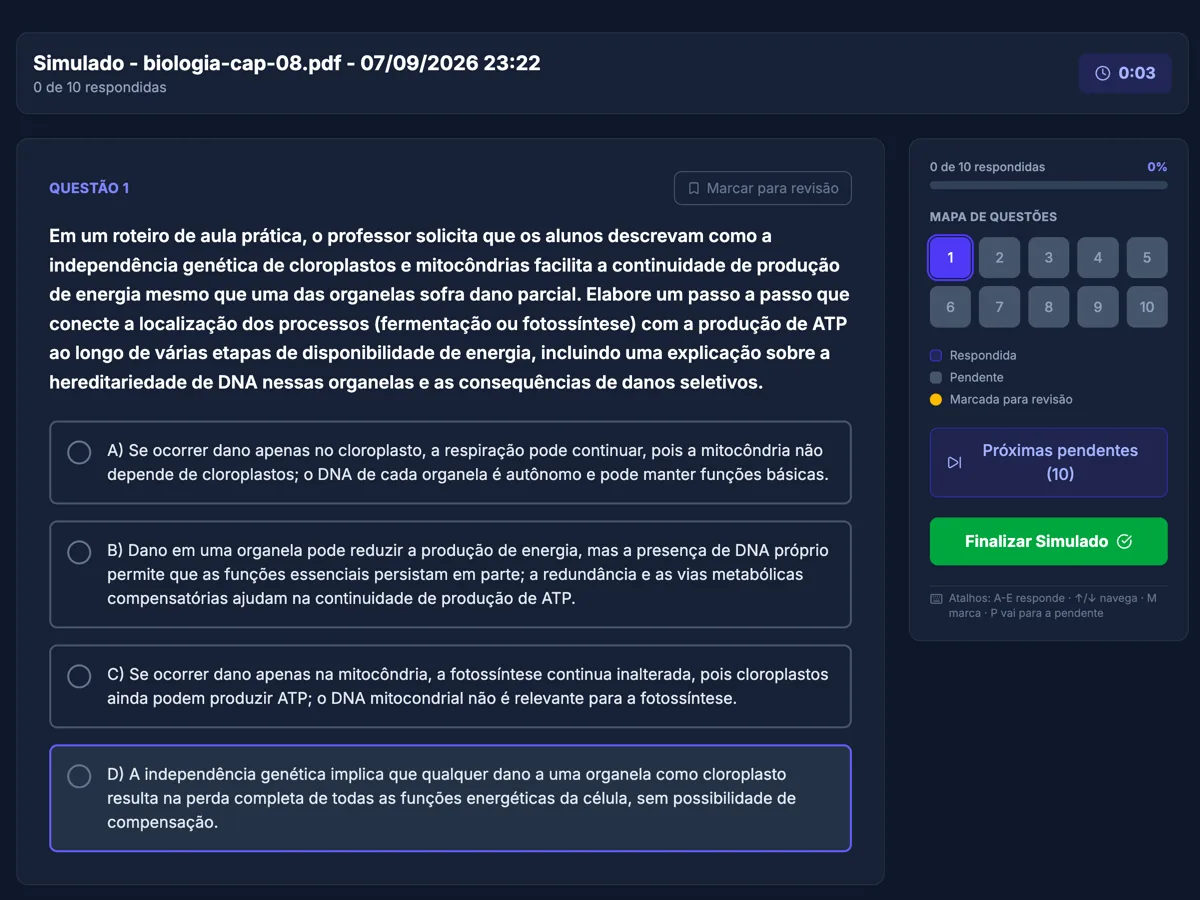
The platform’s design reflects these findings directly. While building the test generator, I realized the practical bottleneck of active recall is the supply of fresh questions: people who study from PDFs and notes rarely have a second batch of questions on the same material — so they redo the same ones and slide into memorizing the answer key. That is why the core flow is generating, each round, a different practice test on the same content, with an explanation for every question. The mistake I see most often among people using the platform is the symmetric opposite: retaking the same test until they ace it and feeling they have “closed out” the topic. That feeling is exactly the deceptive fluency of rereading, dressed up as a question.
In my own routine, flashcards handle facts and definitions, practice tests handle applied reasoning, and mind maps get a less obvious use: I try to redraw the structure of a subject from memory before opening the finished map — that is retrieval practice too. None of this requires the platform, to be clear: hand-written questions at the end of a reading session already put the principle to work. The tool just removes the friction.
Common mistakes to avoid
- Rereading as your main strategy: it comforts, but it does not consolidate.
- Redoing the same questions: you memorize the test, not the subject.
- Studying only what you already know: pleasant and unproductive. Go to your mistakes.
- Skipping the explanations: an answer key without understanding only teaches you the key.
- Trusting the feeling of mastery: the experiments show it cannot tell what will be remembered from what will be forgotten.
A fourth reread rarely adds what a single test reveals. On the next topic you need to review, try inverting the ratio: read once, close the material and answer questions. The first round will sting your ego a little — mine did — and it will show you, with a clarity no rereading offers, what you actually know.
References
- Karpicke, J. D., & Roediger, H. L. (2008). The Critical Importance of Retrieval for Learning. Science, 319(5865), 966–968. https://www.science.org/doi/10.1126/science.1152408
- Roediger, H. L., & Karpicke, J. D. (2006). Test-Enhanced Learning: Taking Memory Tests Improves Long-Term Retention. Psychological Science, 17(3), 249–255. https://journals.sagepub.com/doi/10.1111/j.1467-9280.2006.01693.x
- Adesope, O. O., Trevisan, D. A., & Sundararajan, N. (2017). Rethinking the Use of Tests: A Meta-Analysis of Practice Testing. Review of Educational Research, 87(3), 659–701. https://journals.sagepub.com/doi/10.3102/0034654316689306
- Karpicke, J. D., Butler, A. C., & Roediger, H. L. (2009). Metacognitive strategies in student learning: Do students practise retrieval when they study on their own? Memory, 17(4), 471–479. https://www.tandfonline.com/doi/abs/10.1080/09658210802647009