How to study from videos and recorded lectures with VideoLab
Watching a recorded lecture is rarely enough to learn. Here is how to turn videos into active study, with questions and review, using VideoLab.
Recorded lectures, video lessons and talks have become a central study source, but watching, on its own, is one of the most passive ways to learn. It is easy to reach the end of an hour-long video having retained almost nothing. The idea is to turn the video from something passive into something you actively engage with: a starting point for questions, active recall, and review.
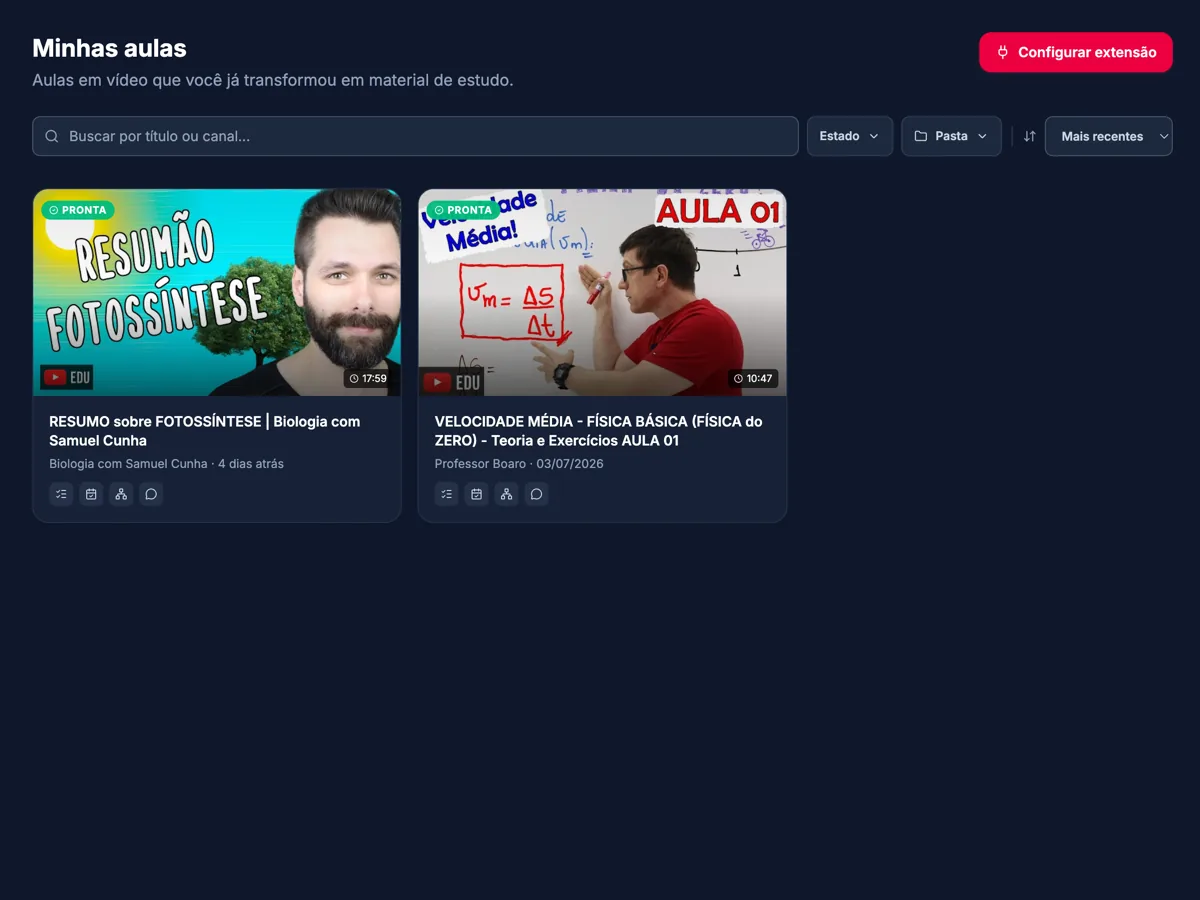
Why just watching does not work
The video controls the pace, not you. Information flows continuously and the brain, with nothing to produce, slips into passive mode. Add the false sense of productivity, “I watched the whole lecture”, and you have the recipe for effort without return. Research on active learning shows that generating questions, rephrasing concepts in your own words, and self-testing during or after a video activate cognitive processes that passive viewing simply does not trigger. To learn from a video, you have to interrupt it with questions and force it to become raw material for active recall.
The cost of 2x speed
Speeding up the video feels efficient, but it has a price: for new and complex material, normal speed tends to preserve comprehension better, because the brain needs time to process and connect ideas as they emerge. Save 2x for reviewing something you already understand, not for first contact with a hard topic.
1. Set the goal before you press play
Before you start, decide what you want to extract from that video: is it a first exposure to a new topic, a deep dive or a review? The goal changes how you watch. For a new topic, a first pass to grasp the whole before diving into details is worthwhile. For review, skip straight to the points you know are weak.
2. Actively engage with the content
Instead of watching in silence, turn the video into a dialogue. An AI video assistant lets you ask about points that stayed unclear, request that a passage be explained another way, and check whether you understood a concept by rephrasing it in your own words. That active conversation breaks the passivity, you stop receiving and start interrogating the content, which is precisely what supports deeper comprehension.
- Pause and ask as soon as something sounds confusing, instead of pressing on and hoping it clears up.
- Request examples when the concept is abstract; a concrete example sticks better than a definition.
- Rephrase in your own words and verify, if you cannot rephrase it, you do not yet understand it.
3. Turn the video into questions
After watching, the step that separates remembering from forgetting is testing yourself. Generate questions on the video's content and answer them without going back to it. The mistakes show exactly which passages deserve a second pass, and now you rewatch with purpose, going straight to the point instead of replaying the whole hour.
4. Connect the video to your other materials
A video is rarely the only source for a topic. After extracting the essentials, it is worth integrating it with the rest of your study: a mind map that joins what came from the video with what came from the book, or a slide deck that organizes everything into a single sequence. Cross-referencing different sources is what adds depth and reveals contradictions or gaps that a single source would hide.
Notes that are actually useful
Transcribing the video word for word is wasted work, it becomes passive copying. Instead, write down only what answers a question of yours, record doubts to resolve later, and mark the timestamps of the hard passages to revisit. Good video notes are not a complete summary; they are a map of the points you still need to master.
5. Review at intervals, not all at once
Like any content, what you took from a video fades if it is not revisited. Instead of rewatching everything, return to the questions you generated a few days later and try to answer them from memory. Rewatching the whole video is expensive in time and poor in return; testing yourself again is fast and efficient.
Common mistakes to avoid
- Watching start to finish without pausing: a passive hour yields little. Interrupt it with questions.
- Confusing “I watched” with “I learned”: only active recall confirms learning.
- Rewatching everything to review: test yourself first and rewatch only the weak passages.
- Treating the video as a single source: cross it with book and notes to gain depth.
Used well, a video stops being an hour of passive attention and becomes the start of an active study cycle, watch, ask, test and review. Tools such as SimulAI's VideoLab can support the conversation and question-generation steps; the learning, however, comes from what you do with that cycle.