Multiplayer arena: 5 rituals to engage the class without turning into an empty quiz
The arena is fun, but it can devolve into noise if poorly applied. Five simple rituals to turn competition into real learning.
Classroom competition has a bright side, energy, focus, full attention for the next twelve minutes, and a dark side, when it becomes noisy spectacle without learning. The difference between the two almost never lies in the tool, but in the ritual around it. Below are five rituals we use with partner teachers so that SimulAI's multiplayer arena becomes real learning, and not just an empty quiz.
Why rituals matter more than rules
A ritual is a predictable sequence that gives the activity meaning. When students know what comes before and after the competition, the thrill of the game anchors to a purpose. Without it, the ranking becomes the center, and the content, a detail. The five rituals below are simple and can be adopted in your very next class.
How to open an arena in seconds
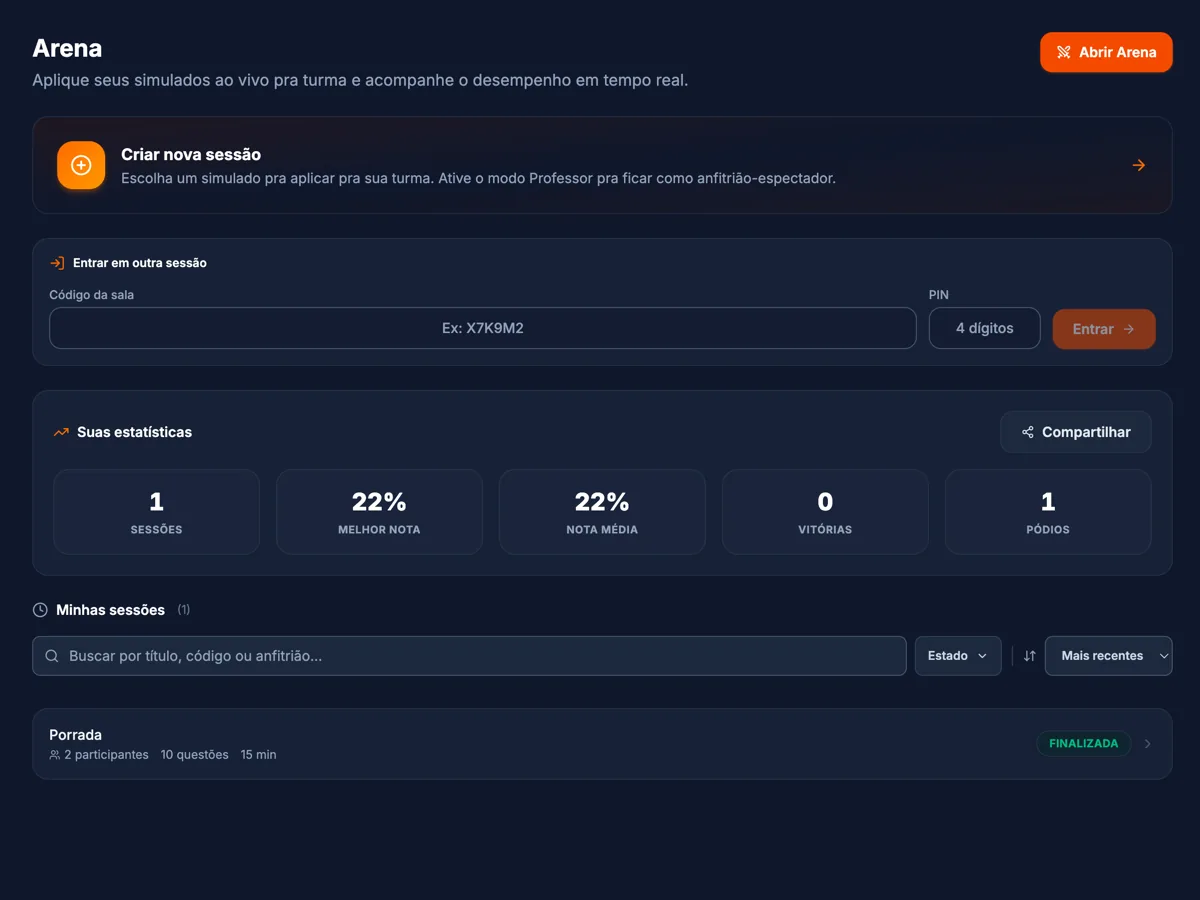
For those who haven't used it yet: from any test, click Open Arena. The system generates code and password automatically; students join from the browser, with nothing to install. You control the time per question and the pace. Everything we describe below assumes this few-click flow, the hard part is never the technology, it is the ritual.
1. Announce the topic, not the scoreboard
Always start with the learning objective of the session: “today we'll consolidate the Industrial Revolution.” The ranking is means, not end. When the teacher opens with the content goal, students come in to learn and the competition becomes fuel, not distraction.
2. Discuss the wrong answer, not just the right one
At the end of each arena, the report shows which questions had the most mistakes. Pick two of them and open the floor for collective discussion. Real learning means understanding why the mistake made sense, which conceptual trap led half the class to the wrong option. This is the most valuable moment of the activity, and where the per-question report becomes gold.
3. Mix solo and arena
In our experience with partner teachers, the arena is powerful precisely because it is not daily. Use it once a week, as a closer or a warm-up; on other days, prefer the solo test with review at the student's own pace. This alternation keeps the novelty from wearing off and respects those who learn better without time pressure.
4. Rotate teams
Instead of an individual ranking, group students into pairs or trios, and change the composition each round. Teams lower the pressure on those who struggle, encourage peer-to-peer explanation, which peer-learning research describes as highly effective, and reduce the exposure of those who get it wrong. The competition continues, but the mood changes.
5. Reuse the report
Each arena produces a per-question accuracy map. The natural destination for that data is not the gradebook, but your planning. The questions with the most mistakes indicate exactly where the next class should begin. Using the arena as a thermometer, and not as a pop quiz, completely changes the class's relationship with the activity.
Adapting for large or remote classes
The rituals work at any class size, but they call for small adjustments. In large classes, project the live leaderboard so everyone follows along and increase the time per question a little, giving everyone room to answer. In remote teaching, ask students to join from the browser and let cameras stay optional, the arena already creates presence through the shared rhythm of the questions. In both cases, discussing the most-missed questions remains the heart of the activity; that is what turns numbers into learning.
When the arena is not the best choice
Competition is not always the right format, and recognizing that is part of using it well. For a first contact with a hard topic, the solo test, with no timer, usually teaches more, time pressure gets in the way of someone still building the concept. For very anxious classes or sensitive content, prefer rotating teams or individual study. The arena shines at consolidation and review; do not force it when the moment calls for calm.
Signs the ritual is working
- Students discuss the content after the arena, not just who won.
- Those who got it wrong feel comfortable asking why.
- You can point, in the next class, to what changed because of the report.
A final reminder
The technology delivers the code, the password, the timer, and the live ranking. Learning, however, lives in what the teacher does before and after the game. With these five rituals, the arena stops being a fun break and becomes a real part of the teaching cycle.